China has become a major sourcing base for precision transmission components, including the Low Noise Gear Motor. Its advantages include mature supply chains, flexible customization, and competitive production capacity. However, “quiet” cannot be judged from a catalog photograph. It must be measured.
The International Energy Agency reports that electric motors account for roughly half of global electricity consumption. This makes efficient motor design increasingly important in industrial equipment. Grand View Research also identifies continued growth in the global electric motor market, driven by factory automation, robotics, medical devices, and energy-saving systems. These trends raise a practical question: can a supplier reduce acoustic noise without sacrificing torque, service life, or thermal stability?
Gear-design specialist Dr. Robert G. Drago has emphasized, “Quiet operation starts with accurate gear geometry and controlled assembly.” That principle remains useful. A reliable Chinese supplier should provide noise test conditions, speed data, load information, lubricant specifications, and production traceability. ISO 3744 and ISO 1680 can support structured acoustic testing, although results may differ between laboratories and applications.
Look closely.
A motor rated at 45 dB(A) in a controlled room may sound different inside a metal enclosure. Mounting stiffness, resonance, shaft alignment, and surrounding airflow can change the final result. This is where many purchasing comparisons become imperfect. Price is visible. Long-term noise is not.
For global buyers, the strongest supplier is not simply the lowest bidder. It is the manufacturer that combines verified measurements, experienced engineers, stable quality control, and responsive after-sales support. Sample testing still matters. So does honest technical discussion.
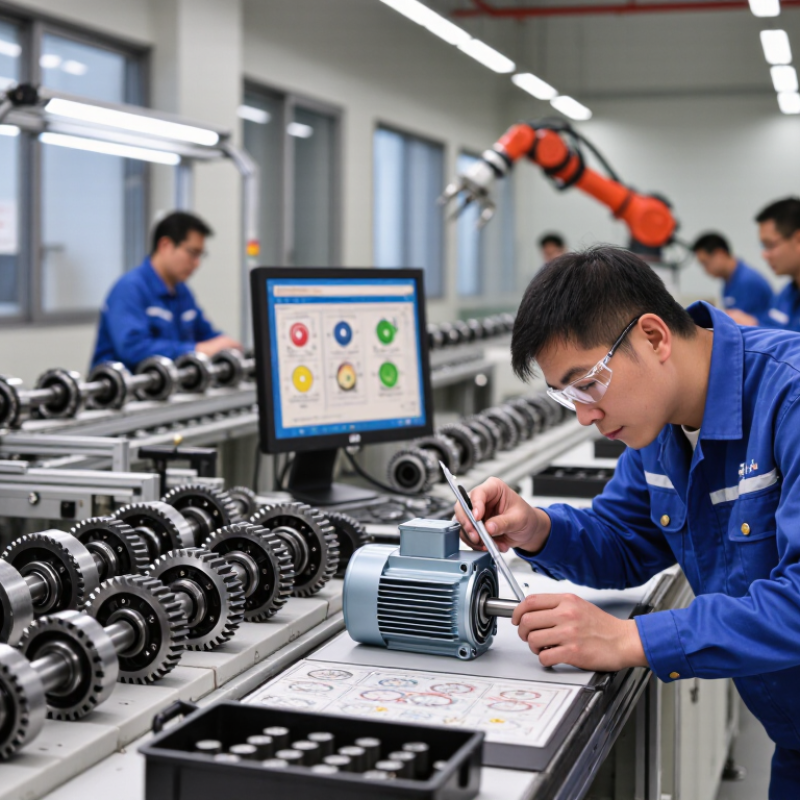
What makes a gear motor supplier the best choice for global buyers? Low noise is important, but it is only one part of a reliable purchasing decision. The supplier should explain measured sound levels, test conditions, gearbox materials, and expected service life. A laboratory reading at one meter may not match a motor installed beside a steel frame. That difference matters.
The International Energy Agency reports that electric motor systems consume roughly half of global electricity. This makes efficiency more than a technical preference. It affects operating costs, heat, and carbon performance. A qualified supplier should provide efficiency data, torque curves, duty ratings, and clear tolerance information. IEC 60034-9 offers recognized sound-level guidance for rotating electrical machines, while ISO 3744 supports sound-power testing. Buyers should request test records, not only attractive specifications.
Practical experience also reveals smaller details. A quiet gear motor should start smoothly, hold speed under changing loads, and avoid excessive vibration after long operation. Suppliers serving global buyers need stable documentation, traceable quality control, export-ready packaging, and responsive engineering support. Spare parts availability is often overlooked. It should not be.
No supplier is perfect. Noise can increase with misalignment, worn bearings, or poor mounting. A serious supplier admits these risks and explains preventive checks. Before ordering, buyers can compare sample units, operating temperatures, warranty terms, and inspection procedures. The best choice is not always the cheapest quotation. It is the supplier whose evidence remains useful after installation.
Practical supplier-selection criteria for buyers evaluating low-noise gear motors for international applications.
| Evaluation Dimension | Recommended Benchmark or Data Range | Why It Matters to Global Buyers | What the Supplier Should Provide |
|---|---|---|---|
| Operating Noise | Approximately 45–65 dB(A) at 1 m for many compact gear-motor applications, depending on motor size, gearbox type, speed, load and test method. | Lower noise is important for office equipment, medical devices, laboratory instruments, smart-home products and indoor automation. | Noise-test reports that identify distance, load, speed, mounting condition, ambient noise and measurement standard. |
| Gearbox Technology | Helical, planetary and precision spur gearboxes are commonly considered when efficiency, compact size, torque density or controlled backlash is required. | The gearbox design affects sound level, efficiency, service life, torque capacity and overall product size. | Gearbox drawings, transmission ratio options, material specifications, lubrication details and application recommendations. |
| Rated Voltage | Common DC configurations include 6 V, 12 V, 24 V and 48 V; AC options depend on the target market and application. | Correct voltage compatibility helps buyers integrate the motor with existing power supplies, controllers and battery systems. | Voltage tolerance, no-load current, rated current, stall current and recommended controller information. |
| Output Speed | Typical geared output speeds range from below 1 rpm to several hundred rpm, depending on the motor and reduction ratio. | Output speed determines positioning accuracy, operating cycle time, conveyor throughput and actuator performance. | No-load speed, rated-load speed, speed tolerance, reduction ratio and speed-versus-torque curves. |
| Output Torque | Torque must be specified at the actual operating speed and duty cycle; continuous torque and peak or stall torque should be listed separately. | A motor may reach its peak torque only briefly, so continuous-load data is essential for reliable sizing. | Continuous torque, peak torque, stall torque, permissible radial load, permissible axial load and duty-cycle limits. |
| Efficiency | Overall efficiency varies significantly by motor construction, reduction ratio, lubrication and operating point; measured values should be supplied rather than assumed. | Higher efficiency can reduce heat generation, energy consumption and battery drain. | Efficiency curves or test data at specified voltage, speed, torque and temperature conditions. |
| Backlash and Positioning | Backlash is application-dependent and should be reported in degrees at the gearbox output under a defined measurement load. | Low backlash supports accurate movement in robotics, dosing systems, actuators and positioning equipment. | Backlash measurement method, repeatability data, encoder options and recommended control parameters. |
| Service Life | Expected life depends on load, speed, temperature, lubrication, duty cycle and mounting. A fixed life figure is meaningful only with test conditions. | Reliable life data helps buyers estimate maintenance intervals, warranty exposure and total ownership cost. | Life-test conditions, load profile, operating temperature, failure criteria and sample-size information. |
| Thermal Performance | Motor temperature rise should be evaluated at the intended load, speed, ambient temperature and duty cycle. | Excess heat can reduce insulation life, damage nearby components and limit continuous operation. | Temperature-rise tests, insulation class, thermal protection options and permissible ambient-temperature range. |
| Ingress Protection | IP ratings such as IP44, IP54, IP55 and higher indicate different levels of protection against solids and water; the complete assembly rating must be confirmed. | Protection requirements vary between indoor, dusty, humid, outdoor and washdown environments. | IP test documentation, sealing design, cable-entry details and installation limitations. |
| Quality Management | A documented quality-management system, commonly aligned with ISO 9001, supports consistent process control and traceability. | Controlled production processes reduce variation between batches and simplify supplier audits. | Valid certificates, inspection plans, incoming-material controls, in-process checks and corrective-action procedures. |
| International Compliance | Compliance requirements depend on the destination market, voltage system and final equipment; applicable declarations and test reports should be verified. | Proper documentation can reduce customs delays, redesign risk and market-entry problems. | Relevant safety, electromagnetic-compatibility and restricted-substance documentation for the intended market. |
| Customization Capability | Common customization areas include shaft geometry, mounting holes, connectors, cable length, gear ratio, encoder and braking options. | Application-specific modifications can reduce assembly work and improve mechanical or electrical compatibility. | Engineering drawings, design-review process, prototype procedure, change-control records and sample approval workflow. |
| Sample and Validation Support | A professional supplier should support prototype samples, specification confirmation and performance validation before mass production. | Early testing helps identify noise, torque, heat, vibration and integration issues before large orders are placed. | Sample lead time, test checklist, dimensional inspection report and acceptance criteria. |
| Production Capacity | Capacity should be assessed against the buyer's monthly demand, forecast variability, tooling requirements and required delivery schedule. | Balanced capacity reduces the risk of extended lead times during product launches or seasonal demand increases. | Capacity plan, production lead time, equipment list, bottleneck controls and backup manufacturing arrangements. |
| Packaging and Export Logistics | Export packaging should protect against shock, vibration, moisture and corrosion during international transportation. | Suitable packaging reduces transit damage and supports efficient warehouse handling. | Packaging specifications, pallet dimensions, labeling format, shipping documents and quality checks before dispatch. |
| Total Cost of Ownership | Evaluation should include unit price, tooling, testing, freight, energy use, installation time, maintenance and expected service life. | The lowest purchase price does not always provide the lowest long-term operating cost. | Transparent quotation, tooling charges, warranty terms, spare-parts policy and documented performance assumptions. |
Note: Noise, torque, efficiency, service life and protection ratings vary by model and operating conditions. Buyers should compare data measured using equivalent test methods and request application-specific validation before final approval.
A reliable supplier provides measured noise data, efficiency figures, torque curves, and service-life expectations. Documentation should remain clear after installation. Responsive engineering support also matters.
Ask for the distance, speed, load, and test environment used during measurement. A reading taken one meter away may differ beside a steel frame. That matters.
No. The motor should also start smoothly, maintain speed, and control vibration under changing loads. Quiet operation alone can hide weak torque or poor service access.
Helical gears can reduce tooth impact during operation. Precision machining supports consistent contact, while sealed bearings can limit shaft movement. Designs vary.
Test the motor at low speed, during reversing, and through overnight operation. Check the housing for uneven heat. Listen near the gearbox.
Request insulation data, load-life records, tolerance details, inspection procedures, and test conditions. A single catalog number is not enough evidence.
Export-ready packaging helps protect the motor during long transport. Available spare parts can shorten downtime when bearings or gears wear. This is often overlooked.
Not always. Compare sample units, warranty terms, operating temperature, inspection quality, and expected service hours. Lower price may bring higher maintenance costs.
Misalignment, worn bearings, poor mounting, and excessive loads can raise noise levels. A serious supplier should explain these risks and recommend preventive checks. No supplier is perfect.
Choosing the right China supplier for a Low Noise Gear Motor requires more than comparing prices. Global buyers should evaluate engineering capability, production consistency, communication, quality control, and after-sales support. Low-noise gear motors combine an electric motor with a reduction gearbox to provide controlled speed, stable torque, and quieter operation. They are widely used in automation equipment, medical devices, smart appliances, office systems, packaging machinery, and other applications where smooth and comfortable performance is important.
China-made low-noise gear motors may offer compact designs, efficient transmission, durable materials, precise gears, and flexible mounting options. Buyers should review testing procedures, certifications, inspection records, and product reliability before placing an order. It is also important to confirm customization options, sample approval, minimum order quantities, packaging, lead times, shipping arrangements, and export documentation. A dependable supplier should provide clear technical support and consistent communication from initial inquiry through global delivery. Selecting a qualified partner helps reduce operating noise, improve equipment performance, and support long-term purchasing stability.

 Syncdrive Motor